
The power of plants and dirt

Updated: Apr 27

Appliances that have a single purpose have no place in my house. But give me a gadget that can accomplish many things and it gets prime real estate on my kitchen counter.
That’s the kind of thinking baked into the new horizontal levee in the City of Palo Alto. What’s a horizontal levee, you ask? Good question!
First though, let’s use a less yawn-inducing term that might get y'all to read more - "Living" levee.
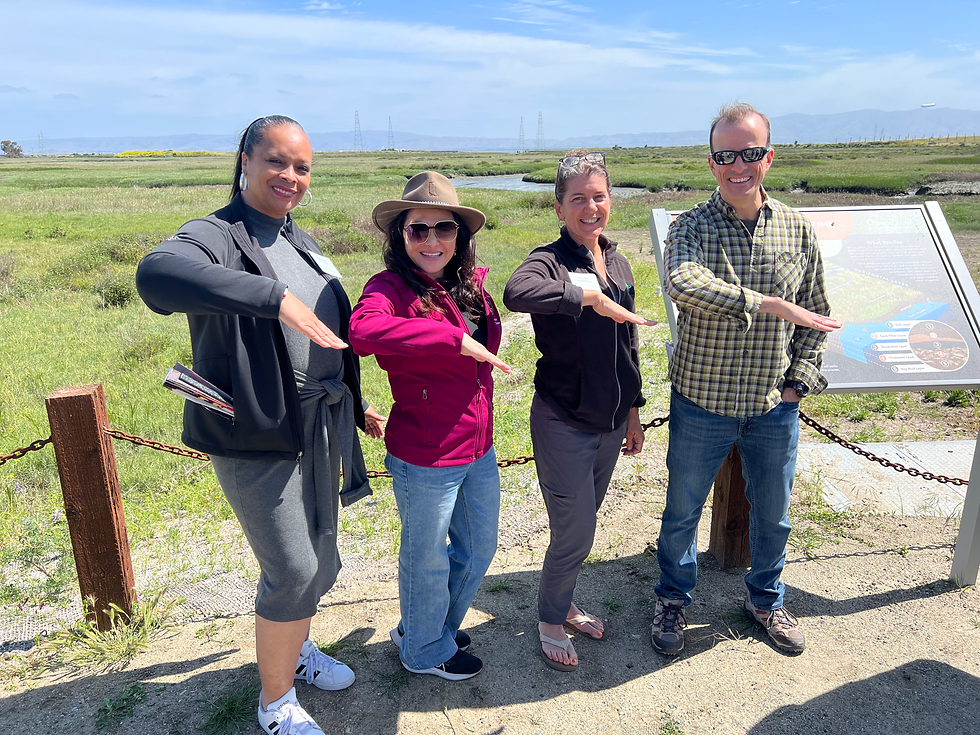
So what is it and what is the problem we’re trying to solve?
You, the general public, are probably most familiar with sea level rise and flooding as problems in need of our urgent attention. That is true for the City of Palo Alto. In fact the current levee system is not FEMA certified and regularly experiences overtopping. Additionally:
- Marsh habitat is in need of restoration
- Wastewater needs to be discharged into the Bay in a clean state
- People need areas to recreate and commute safely
To accomplish all those things, instead of a flood wall or conventional levee (more like a pile of dirt and rocks), a project was designed to do lots of things, including a trail for bikes/walkers, “polishing” of wastewater, and habitat restoration. This is not unlike the Shoreline restoration projects linked here and talked about in a previous blog on the King Tide Ride, (except for the water polishing part.)
But why the term “living” levee? This refers to the unleashing of the “power of plants and dirt”, as noted by Allison Chan of Save the Bay. On the water side of the levee, there is a gentle slope and at the higher levels, native plants are planted with the intent of becoming healthy marsh habitat. Hence the term living levee. It’s not just a bunch of mounded dirt with “rip rap” (a term used for rocks and boulders to prevent erosion.) The levee mimics what the earth would naturally do, restoring natural functions all while protecting against sea level rise.

I also want to take a moment to talk about the term “polishing.” In this case, water from the neighboring waste water treatment plant (the plant that serves Palo Alto, Los Altos, Los Altos Hills, Stanford, Mountain View and East Palo Alto) is used to irrigate the new habitat. That water then is “treated” by the plants, pulling out the toxins and breaking them down so that they don’t end up in the Bay.
Isn’t nature amazing?! It cleans the water for us!
I’ve linked to several places where you can dig into the details of this project but before signing off, I want to highlight one thing. We know sea level rise is here and in fact, cities are required to put plans in place to show how they will adapt over time. At the same time, some cities are moving forward to pave over undeveloped lands near the Bay. San Jose, for example, is hell bent on attracting additional data centers and sees the area north of 237 as a prime location. This location is also an area that the Water District has current assets, the purification center being one, and plans to build an additional purified water facility. But there’s a difference between projects with a huge public benefit and those that don’t. Why cover undeveloped land near the Bay when we need that land to insulate us against sea level rise as well as to continue providing the valuable functions nature provides, NATURALLY.
If you’re interested in learning more about the living levee and nature based solutions, follow the links below.
As an aside, I rode my bike to and from the tour, a lovely 44-mile pedal along the Bay Trail. I saw birds including baby geese, rabbits, snails and the sunrise. It was a wonderful way to start and end the day. Thank you to Save the Bay for putting together a great tour!





Comments