
Day 3: Bike sailing the Delta

Updated: Jun 16

Before getting started on day 3, we pedaled over to downtown Antioch for high tea with a friend. This friend also offered to drive us over the Antioch bridge because as mentioned in the day 2 write up, while we’re confident cyclists, the Antioch bridge looked like a death trap. It’s nice to have friends who go way out of their way to help out.
A little story
The night before we took Lyft to check out the bridge and then eat. The driver arrived in a
pretty beat up car and I was like, hmm, what does it say to get into a Lyft when the car looks like this? Regardless, as we approached our destination, she started rummaging around in a box in the passenger seat. Finally she found what she was looking for and handed us a booklet of daily Christian scripture readings. In broken English she encouraged us to read it and wished us well. What better way to spread the gospel of Christ than to disguise yourself as a Lyft driver?!
The next day we woke up and I read Day 2’s scripture lesson. The main lesson had to do with slowing down in order to be more intentional about what you choose to put into your brain. In this case, scripture (over social media and negativity). But the main message was, first, you gotta slow down and pause in order to be able to not put garbage in your brain.
We then arrived at high tea and over the course of our conversation with the fairly new business owner (Hen and Drake was the name of the tea house), she mentioned that one of her goals is to help people slow down. High tea is slow. You eat all these cute little treats over a long period of time with many pots of tea while enjoying the company of friends and good conversation.
All this on a four day trip by bike to Sacramento where I could have just driven up but wanted to take the time and slow down… Anyway, regardless of what folks think about tea or God or bikes, slowing down is definitely a good thing to do.
Back to the main program

We finished tea, loaded the bikes, and made our way to the Antioch bridge. Even in a car it was harrowing.
As noted in the day 1 blog, one of the goals of the trip was to ride through the Bay-Delta. Reasons for that are outlined in a previous blog but in short, I’m an alternate board member on the Delta Conveyance Authority, the organization tasked with building a ~45 mile pipe from Hood (north Delta) all the way south. This pipe is intended to fix some of the problems associated with the current way California moves water through the Delta and capture surplus water in heavy flows. There are many, many, many interests in and around the Delta – farmers, birds, fish, environmentalists, community members, water users that depend on water flowing through the Delta, which includes Valley Water – and we’re all not in agreement about how or even if a new pipe should be built.
In order to learn more and deepen my appreciation and understanding of all these perspectives, I’ve been doing a lot of learning. This bike trip was intended to help with that, to see and learn about the Delta at bike speed.

So we started off. The first thing to note was that this was one of the windiest days as reported on the news (and as I overheard from locals in the coffee shop the next morning.) It was really fun when the wind was at our back – no pedaling required. Bike sailing! But for the most part, we were fighting to stay upright with winds coming at us sideways. I imagined myself getting blown into irrigation ditches and as a result, Dan and I often rode in the middle of the road (levee roads).
Despite the wind, the ride was beautiful. So many birds! We saw a family of swans. We saw egrets. It was amazing to see what folks call the lungs of California support such amazing plants, bugs, birds and more. For more information about the Bay-Delta, click here for a previous blog. And if you’d like to learn more about this area and also state water development, I highly recommend the books The Dreamt Land and Battling the Inland Sea. Both chronicle the story of how the gold rush and hydraulic mining along with our hubris, led to the system of levees in the Bay-Delta, an effort to control water, keep it off farm land, and fight the onslaught of sediment caused by hydrolic mining that raised river beds and exacerbated flooding. It is also a story of how powerful people rig the system for their own profit at the expense of nature, tax dollars, and the common good, something that goes on today as we speak.
More on the Bay Delta
The Bay Delta is made up of a web of levees erected to keep water off highly productive land. The levees protect against flooding and keep salt water out, something that will get harder with sea level rise. Interestingly, levees are at risk of faltering due to all sorts of circumstances. One of them I learned about on the Water Education Foundation tour – a little rodent called a nutria (also referred to as a swamp rat). By burrowing into levees, the structure gets compromised and prone to erosion, something tidal action is a master at.
Most recently, movement has been made in furthering protection of the Bay-Delta through the Healthy Rivers and Landscapes (HRL) program which promises to pair the right types and timing of water flows for fish health, and restore habitat. There’s currently a bill authored by Senator McNerney to allocate money for this purpose. I’m oversimplifying and it’s important to note that figuring out how to solve these issues is a monumental task.
The rich history of building out agriculture in the Delta
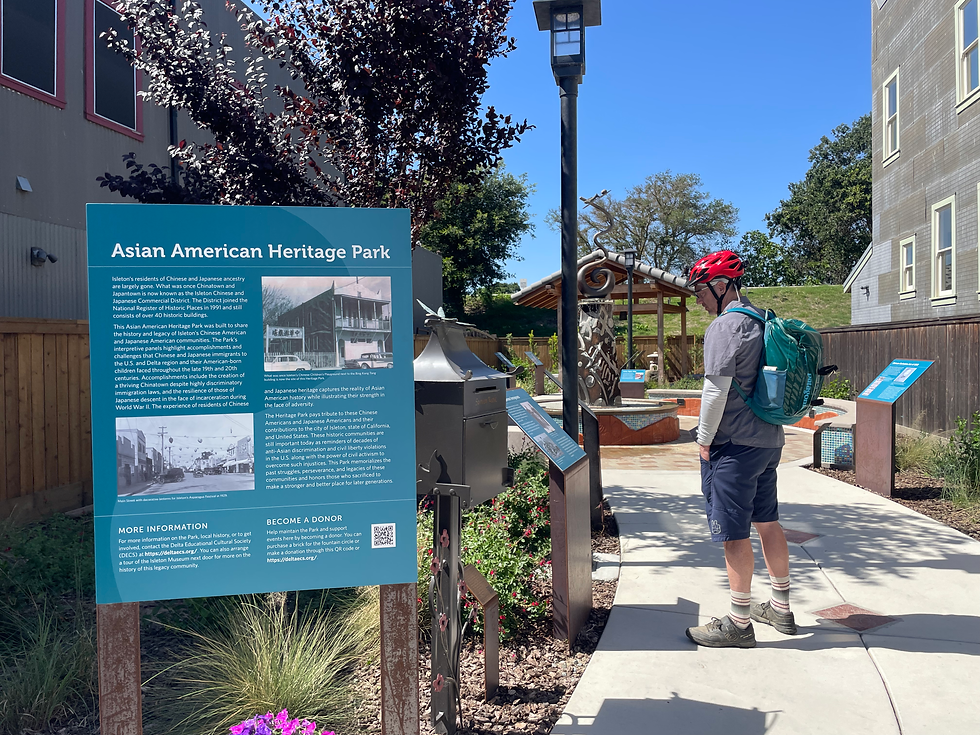

There’s also an incredible amount of history in the Delta. Isleton, during the heyday of the Delta was a town where Chinese, Japanese, and Filipino populations lived. Similar to the building of the railroads, immigrants from China, Japan and the Philippines were instrumental in building the levees. This part of the story is also fraught with racism and discrimination. We stopped in Isleton at a monument to learn about it. Linked here is more information from the Delta Education Cultural Society.

We then pedaled to our final destination, Walnut Grove. Our Airbnb there was one of the most special airbnb’s I’ve stayed at, and I’ve stayed at a lot! It was a pear farm where they also raise goats, chickens and guineas. They raise goats for “brushing” mainly, which I learned is those packs of goats you’ll see on hillsides for vegetation management. It was fun to learn from our hosts all the things they do on the farm to use what they make (pear everything!) They had just made a batch of meade and it was delicious. Also, they sent us off with hard boiled eggs from their guineas, a fowl from Africa. The yolks were so creamy, rich, and flavorful.

That night we walked to Locke, another town that was home to Chinese Americans where we dined at Al Wop and had pork chops and steak. I could spend time describing it but you should just go there to experience and learn the history yourself. And stay at the same Airbnb. It was extra special.
Sidenote: In an attempt to understand what the average person who lives in Walnut Grove thinks about the Delta Conveyance Project, I asked our hosts their thoughts. (We had passed a lawn sign on the way in that said, "stop the tunnel!" Or something to that effect.) The response I got was not a super strong pro or con opinion but rather that of a family that wakes up every day with a zillion things to do between working a 9-5 job and managing a farm. They are focused on what’s in front of them, the day-to-day tasks.
Day 4 was the final day and I’m not sure I’ll write that day up. Overall, the trip was either paved trails away from traffic or on levee roads that were safe. I’ve linked to our route here for those who want to do something similar.
And, I’ll end as I started. Bike touring is soooo fun! You get to learn and see things at bike level (slow) which is such a treat. You can stop and smell the roses, observe birds, eat ice cream, or whatever you want whenever because it’s easy to do that on a bike.


Comments